
Does Caffeine Blunt the Benefits of Creatine? The Research Is Mixed
Some studies show high caffeine intake reduces creatine's ergogenic effects during high-intensity exercise. The evidence is inconsistent, but the mechanism is worth understanding.
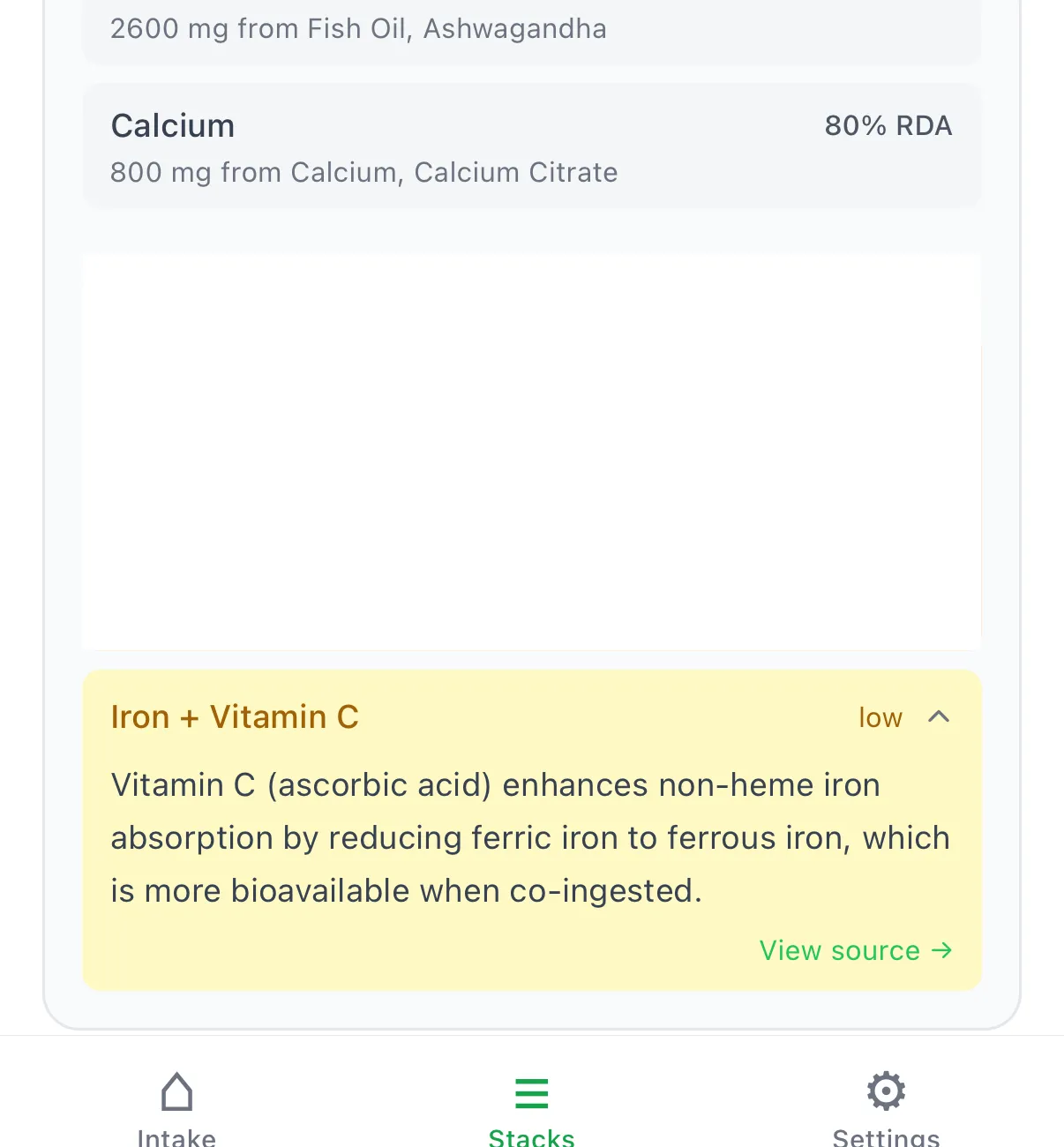
Flagged in Biostacks
Biostacks flags this automatically.
Add Creatine and Caffeine to your stack and Biostacks checks for this interaction in real time.
Creatine and caffeine are two of the most studied and most used performance supplements. They are often found together in pre-workout formulas, so the assumption is that they work well together. A subset of the research literature raises a more complicated picture.
What each does independently
Creatine monohydrate increases intramuscular phosphocreatine stores. During high-intensity exercise, phosphocreatine provides a rapid source of ATP, the energy currency of muscle cells. Supplementing creatine has been consistently shown to improve performance in short, intense bursts of effort: sprints, heavy resistance sets, and repeated high-power outputs.
Caffeine is an adenosine receptor antagonist. It reduces the perception of fatigue, improves alertness, and through separate mechanisms increases calcium release in muscle cells, which enhances muscle contraction force. Caffeine reliably improves endurance performance and has documented effects on power output, particularly in aerobouts lasting one to several minutes.
The interaction finding
A 1996 study by Vandenberghe and colleagues found something unexpected: subjects who took creatine plus caffeine failed to show the performance improvements seen in subjects who took creatine alone. The creatine-only group improved isometric force production and exercise torque; the creatine-plus-caffeine group did not, despite similar creatine loading.
The proposed mechanism involved caffeine’s effect on muscle relaxation time. Creatine supplementation is associated with faster muscle relaxation between contractions. Caffeine appears to slow muscle relaxation by altering calcium handling in muscle fibres. The two effects may counteract each other, with caffeine interfering with one of the specific mechanisms through which creatine improves performance.
The replication problem
The 1996 study is frequently cited but has not been consistently replicated. Several subsequent studies found no significant negative interaction between creatine and caffeine, and others found the combination to be at least as beneficial as creatine alone.
The discrepancy may relate to caffeine dose, creatine loading protocol, exercise type, and individual variation in caffeine metabolism. People who are regular caffeine users show attenuated acute responses to caffeine, which complicates cross-study comparison.
The practical picture
For most people using creatine and caffeine together as part of a training routine, the evidence does not support abandoning either supplement. The interaction, if real, appears to be modest and context-dependent. The more relevant consideration is probably caffeine’s effect on sleep quality, which matters for recovery and therefore for the overall benefit of a training programme.
The only scenario where the interaction might warrant attention is someone specifically trying to maximise creatine’s effect on a high-intensity performance outcome who is also consuming caffeine at high doses on the same schedule. In that case, separating caffeine timing from creatine ingestion is a low-cost experiment.
Reference
- Examine.com. "Creatine: Caffeine Interactions." examine.com