
Magnesium and Iron Share an Absorption Pathway at High Doses
High-dose magnesium competes with iron at intestinal transport sites. The effect is smaller than calcium-iron competition but relevant when both supplements are taken in large amounts.
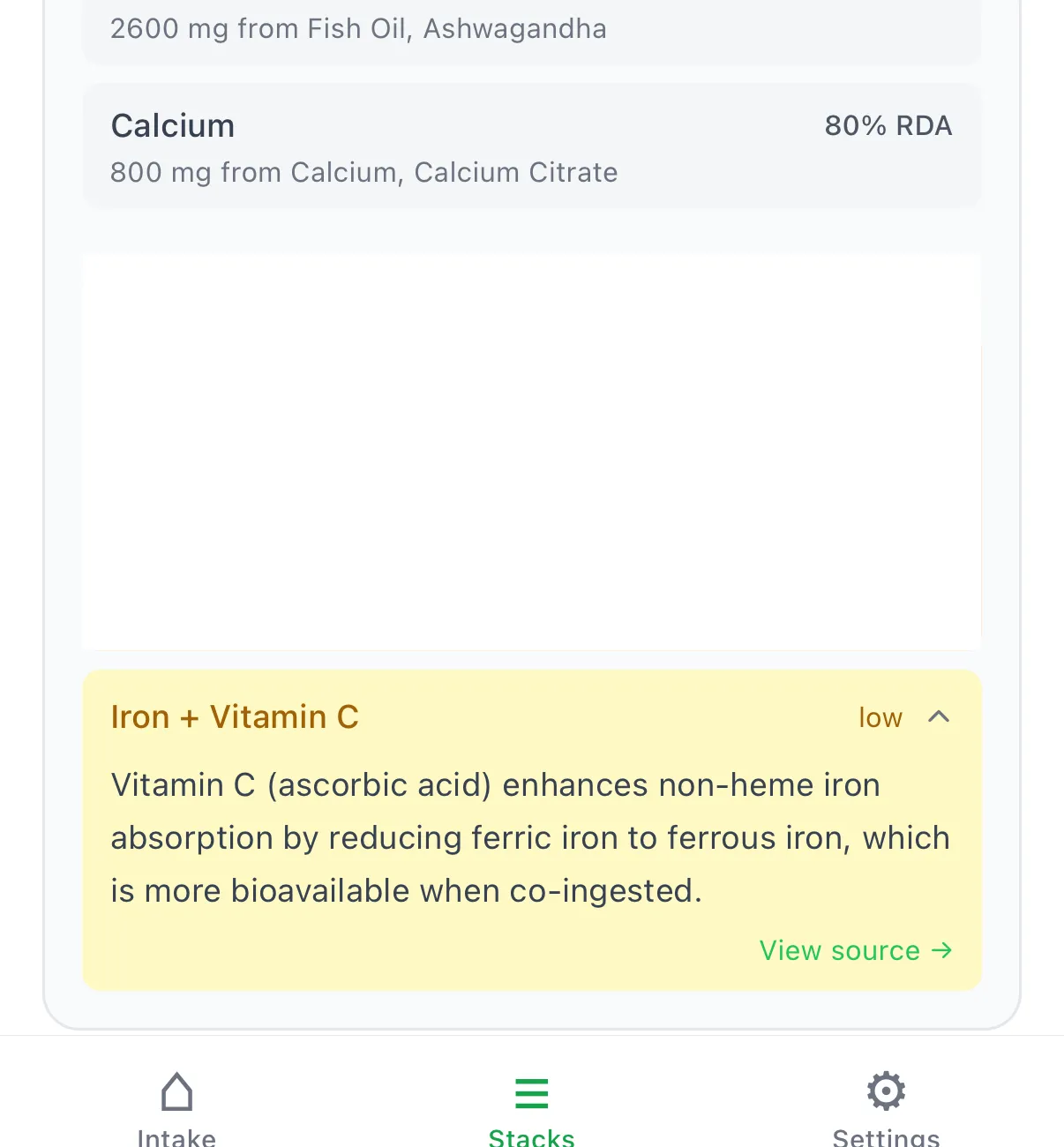
Flagged in Biostacks
Biostacks flags this automatically.
Add Magnesium and Iron to your stack and Biostacks checks for this interaction in real time.
The interaction between calcium and iron is well-documented and widely discussed. The equivalent interaction between magnesium and iron is less well-known but operates through a related mechanism and is worth understanding, particularly for people supplementing both at meaningful doses.
The shared transport biology
Divalent mineral absorption in the small intestine relies on a set of shared transport proteins, most notably DMT1 (divalent metal transporter 1), which handles iron, zinc, manganese, and, to some degree, magnesium. When multiple divalent cations are present simultaneously in the intestinal lumen at high concentrations, they compete for transporter availability.
Magnesium is a divalent cation (Mg²+), as is non-heme iron (Fe²+). At high supplemental doses of magnesium (above roughly 400–500mg taken at one time), the mineral load at the intestinal surface is sufficient to produce some degree of competition with iron uptake.
How significant is the effect?
Research on magnesium-iron competition is less extensive than research on calcium-iron competition, partly because magnesium supplementation at doses high enough to produce meaningful effects is less common and partly because the effect size appears to be smaller.
The calcium-iron interaction at 600mg calcium can reduce iron absorption by 40–60%. The magnesium-iron interaction at equivalent doses appears to produce more modest reductions, but the competition is measurable and consistent with the underlying transport biology.
When it matters
For most people taking a standard magnesium supplement of 200–400mg alongside a daily iron supplement of 18–30mg, the interaction is unlikely to be clinically significant. The concern is proportional to dose:
- People taking magnesium at 400–500mg in a single dose alongside therapeutic iron supplementation for iron deficiency
- People with already-limited iron absorption (vegetarians, people with coeliac disease or inflammatory bowel conditions) where even modest reductions are worth avoiding
- People taking magnesium glycinate or oxide at the upper end of commonly marketed doses
The practical fix
As with all mineral competition interactions, the solution is timing. Taking magnesium and iron at different meals, one in the morning and one in the evening, eliminates the intestinal competition without requiring any change to dose. This is a simple adjustment with no downside.
Reference
- Examine.com. "Magnesium: Mineral Interactions." examine.com