
High-Dose Vitamin C May Destroy Vitamin B12 in Your Stomach
A study found that 500mg or more of vitamin C chemically degrades B12 when both are present together. The fix is simple: separate them by at least two hours.
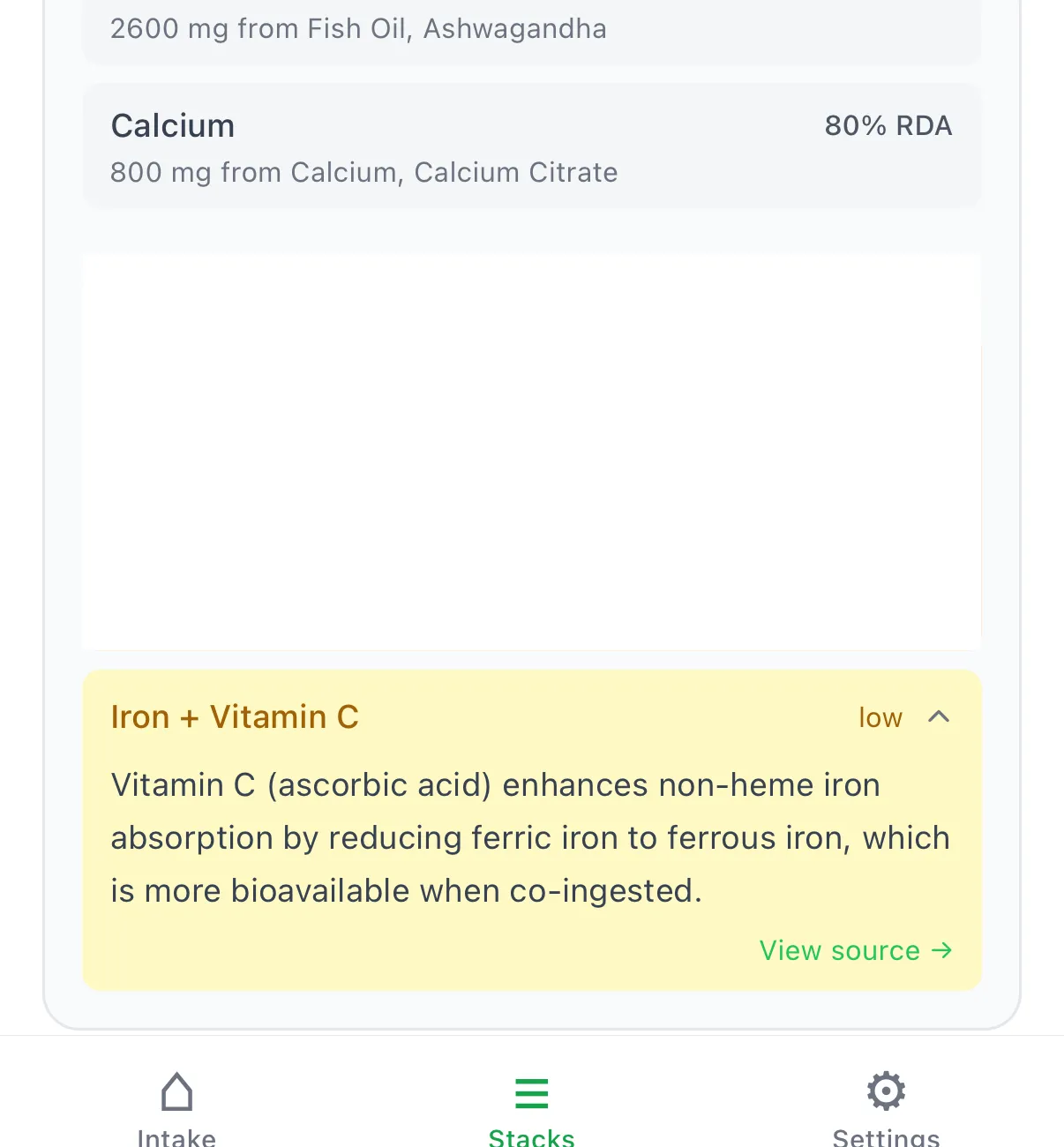
Flagged in Biostacks
Biostacks flags this automatically.
Add Vitamin B12 and Vitamin C to your stack and Biostacks checks for this interaction in real time.
Vitamin C and B12 supplements are both common, both considered safe, and both frequently taken by the same people, often as part of the same morning routine. A finding from the nutritional biochemistry literature suggests the combination, at high doses, may not be as beneficial as assumed.
The chemistry
Vitamin B12 (cobalamin) is a cobalt-centred molecule that is sensitive to oxidising and reducing agents. Vitamin C, ascorbic acid, is a potent reducing agent. Under certain conditions, particularly in an aqueous solution in the acidic environment of the stomach, high-dose vitamin C can chemically reduce and degrade B12, converting it to inactive or non-absorbable analogues.
The reaction is not instantaneous, but it occurs over the time the contents spend in the stomach. A supplemental dose of 500mg or more of vitamin C, ingested at the same time as a B12 supplement, provides enough reducing potential to cause measurable destruction of the B12.
The research
Victor Herbert and colleagues documented this interaction in the 1970s. Their work showed that the percentage of B12 destroyed by co-ingestion with vitamin C increased with vitamin C dose and was most significant at doses above 500mg.
The finding prompted revised dietary advice from some nutritionists recommending that B12 supplements not be taken alongside high-dose vitamin C. It has been cited repeatedly in nutritional pharmacology reviews.
Who is affected
The interaction is most relevant for:
- People taking high-dose vitamin C supplements (500mg or more, often used for immune support or as an antioxidant)
- People who are supplementing B12 because of a deficiency or because they are vegan or vegetarian
- Older adults, whose B12 absorption from food is already reduced and who may be particularly reliant on supplemental sources
For someone taking a standard multivitamin with a small amount of B12 and a moderate amount of vitamin C (typically 60–100mg in most multivitamins), the interaction is unlikely to be clinically significant. The concern applies at supplemental vitamin C doses of 500mg and above.
The easy solution
Vitamin C and B12 do not need to be taken at the same time. Two hours of separation is sufficient to allow gastric emptying and eliminate the opportunity for the chemical interaction. Taking B12 in the morning and high-dose vitamin C in the afternoon, or vice versa, is a practical approach with no downside.
This is a straightforward interaction to avoid once you know about it.
Reference
- Herbert V, Jacob E. "Destruction of vitamin B12 by ascorbic acid." Journal of the American Medical Association, 1974. PubMed 6275638