
Without Enough Magnesium, Your Vitamin D Supplement May Not Work
A 2018 paper found that magnesium is a required cofactor at every enzymatic step of vitamin D metabolism. Low magnesium can render vitamin D supplementation ineffective.
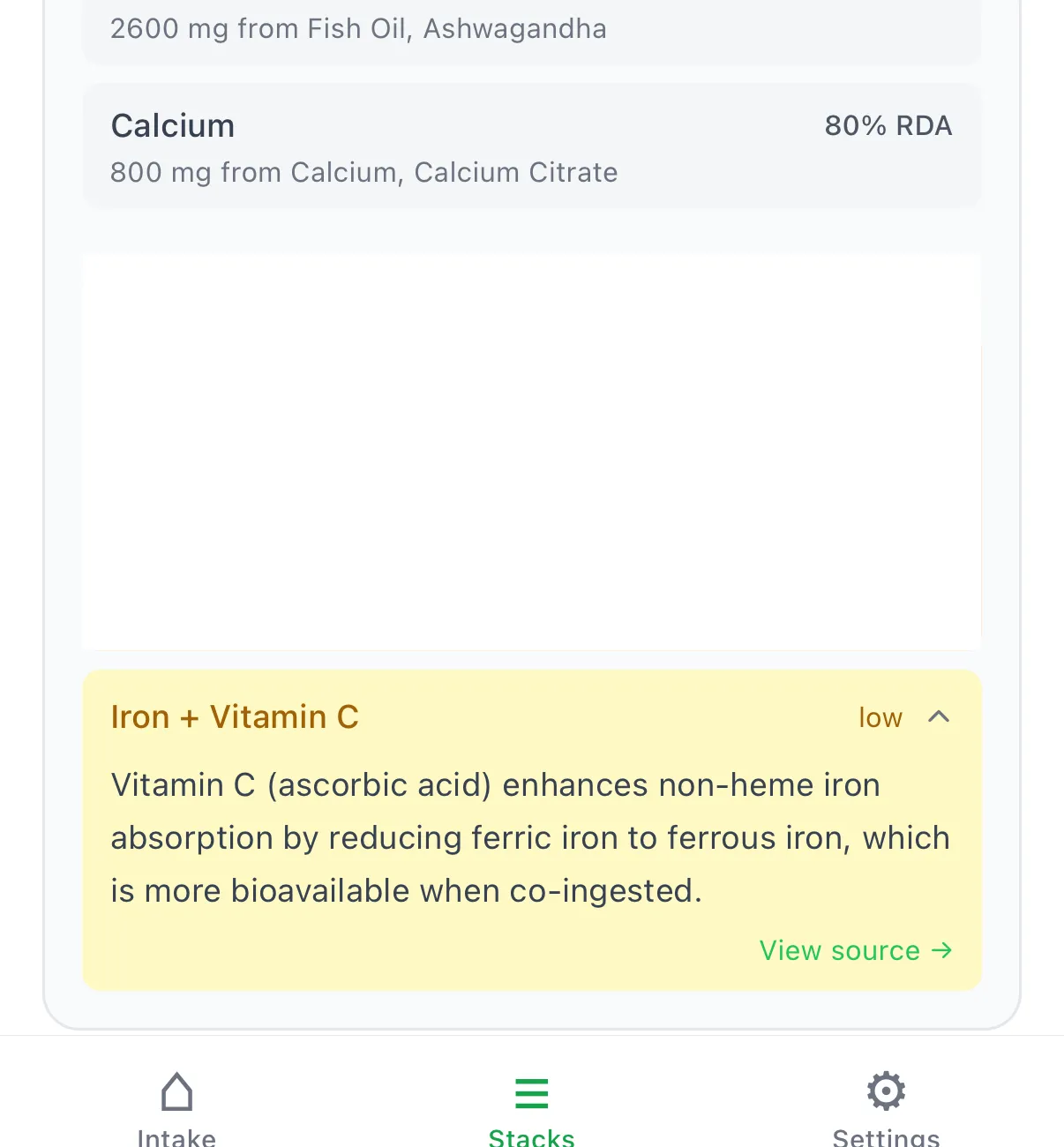
Flagged in Biostacks
Biostacks flags this automatically.
Add Vitamin D and Magnesium to your stack and Biostacks checks for this interaction in real time.
Vitamin D is one of the most widely taken supplements in the world. Most people who take it assume it simply gets absorbed and works. The picture is more complicated.
The cofactor problem
Vitamin D, whether from sunlight or a capsule, does not arrive in the body in an active form. It goes through a sequence of enzymatic conversion steps, first in the liver, then in the kidneys, before becoming the hormone that actually acts on cells. Every one of those enzymatic steps requires magnesium as a cofactor.
A 2018 paper published in the Journal of the American Osteopathic Association by Mohammed Uwitonze and Mohammed Razzaque laid out the biochemical chain clearly. Magnesium is needed for the enzymes that convert vitamin D to its intermediate form (25-hydroxyvitamin D) and then to its active form (1,25-dihydroxyvitamin D, also called calcitriol). Without adequate magnesium, those conversions are impaired.
Magnesium deficiency is common
This would be a minor concern if magnesium deficiency were rare. It is not. Uwitonze and Razzaque cited data suggesting that up to 50% of people in the United States consume less magnesium than the estimated average requirement. Dietary surveys consistently find that magnesium intake has declined alongside the shift away from whole foods toward processed diets.
The people most likely to be deficient overlap significantly with the people most likely to be taking vitamin D supplements: older adults, people with obesity, people with type 2 diabetes, and people with gastrointestinal conditions that reduce absorption.
What the evidence suggests
The authors reviewed clinical trials showing that vitamin D supplementation can fail to raise blood levels of 25-hydroxyvitamin D in people who are magnesium-insufficient. Replenishing magnesium alongside vitamin D produced larger improvements in vitamin D status than vitamin D alone.
There is also evidence that the relationship works in both directions. Vitamin D metabolism consumes magnesium, which means aggressive vitamin D supplementation without attention to magnesium intake can deplete magnesium stores.
Practical implications
For most people taking a standard 1,000–2,000 IU vitamin D supplement daily, the interaction with magnesium is unlikely to be dramatic if their diet is reasonably varied. But for people taking higher-dose vitamin D for a deficiency, and particularly for those on a processed food diet low in leafy greens, legumes, and nuts, checking magnesium intake is a logical step.
A blood test for vitamin D status that returns unexpectedly low numbers despite supplementation is sometimes explained by insufficient magnesium. It is a straightforward thing to check.
Reference
- Uwitonze AM, Razzaque MS. "Role of Magnesium in Vitamin D Activation and Function." Journal of the American Osteopathic Association, 2018. PubMed 29480918